Word files in Dropbox? Make converts them to PDF/A convert, compress, archive in five modules.
Reports, contracts, proposals—often they sit as Word files in Dropbox or other cloud storage. When you need them archived for compliance or retention, a raw .docx isn't enough. PDF/A (ISO 19005) is the standard: fonts embedded, no external links, readable for decades. You can't jump straight from Word to PDF/A—you need to convert to PDF first. In Make, wire up a scenario: download a Word (or Excel, PowerPoint) file from Dropbox, convert it to PDF, compress it, turn that into PDF/A, and upload the archival file. Five modules. One scenario. No manual export.
In a nutshell: Dropbox – Download a File (e.g. /Blog Data/PDFA/Word Sample.docx) → PDF4me – Convert to PDF → PDF4me – Compress PDF → PDF4me – Create PDF/A (e.g. PDF/A-3b) → Dropbox – Upload a File to /Blog Data/PDFA/Output/. Output: PdfA_MakeOutput.pdf in archival format.
Why Convert First, Then Compress, Then Archive?
PDF/A only accepts PDFs. If your source is Word, Excel, PowerPoint, or an image, you must convert to PDF before applying PDF/A. The Convert to PDF module handles DOC, DOCX, PPT, PPTX, XLS, XLSX, TXT, EML, and common image formats. Compress PDF shrinks the file before archiving—smaller files transfer and store faster. Create PDF/A embeds fonts, removes external dependencies, and locks the document for long-term preservation. One scenario does all three—convert, compress, archive.
Complete scenario overview
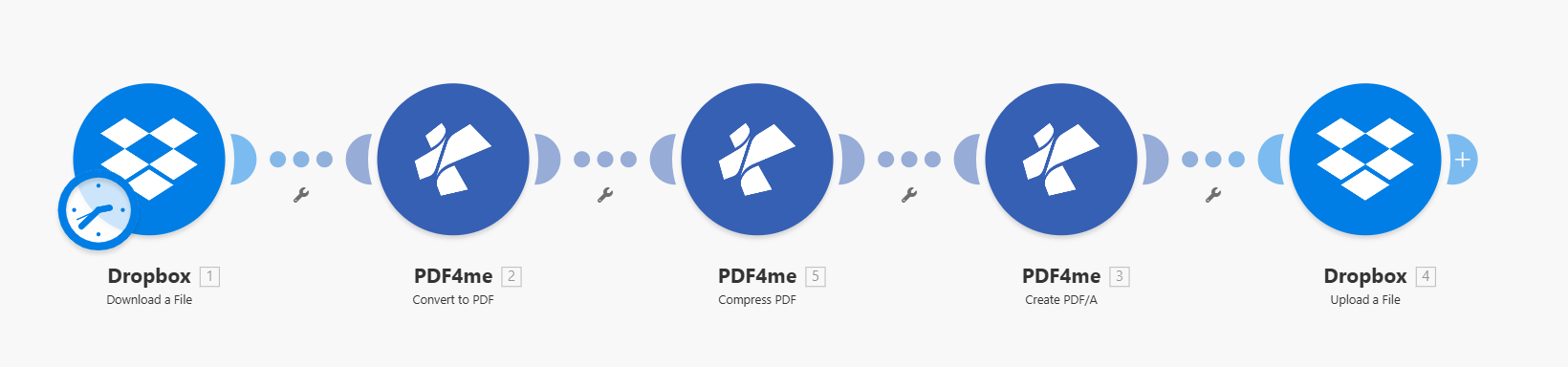
Five modules in sequence: Download → Convert to PDF → Compress PDF → Create PDF/A → Upload. Each module shows a green checkmark when configured.
What You'll Get
Input: A Word document (e.g. Word Sample.docx) or other supported format in Dropbox at /Blog Data/PDFA/. Output: An archival PDF/A file (e.g. PdfA_MakeOutput.pdf) in /Blog Data/PDFA/Output/—ready for compliance, audits, or long-term archives.
What You Need
- Make — Create a Make account and open a new scenario.
- PDF4me API key — Get your API key. Connect it when you add PDF4me modules. First time? See Connect PDF4me to Make.
- Dropbox — For input file and output folder. Google Drive or other storage with Download and Upload works too.
The Scenario: 5 Modules
- Dropbox – Download a File — Gets the source document from a path.
- PDF4me – Convert to PDF — Converts Word, Excel, PowerPoint, or images to PDF.
- PDF4me – Compress PDF — Shrinks the PDF before archiving.
- PDF4me – Create PDF/A — Converts the PDF to an archival-compliant format.
- Dropbox – Upload a File — Saves the PDF/A to your output folder.
Step 1: Download the File from Dropbox
Scenario so far: Download only.
- Add Dropbox → Download a File.
- Connection — Select your Dropbox connection (e.g. YnooxTestone).
- Way of selecting files — Select a file (or use Map for dynamic paths).
- File — Enter the path to your document, e.g.
/Blog Data/PDFA/Word Sample.docx.
Dropbox – Download a File: Configuration
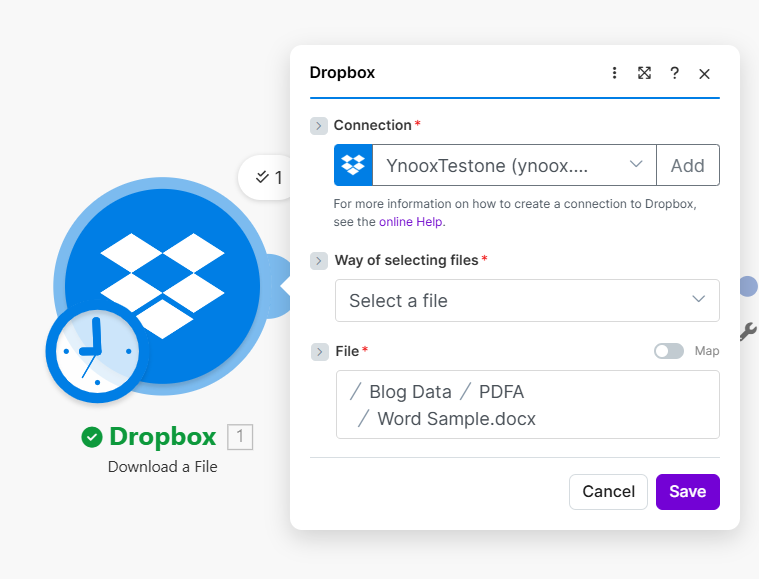
Download module: Connection selected, Way of selecting files (Select a file), File path (/Blog Data/PDFA/Word Sample.docx).
Dynamic paths: Use the Map toggle to pull the file path from a trigger (e.g. When a file is created) for fully automated runs.
Step 2: Convert to PDF
Scenario so far: Download → Convert to PDF.
- Add PDF4me → Convert to PDF.
- Connection — Select your PDF4me connection (e.g. My PDF4me connection).
- File — Select Dropbox – Download a File to pass the document from step 1.
- Save. The module converts the file to PDF using the extension in the source filename.
PDF4me – Convert to PDF: File mapping
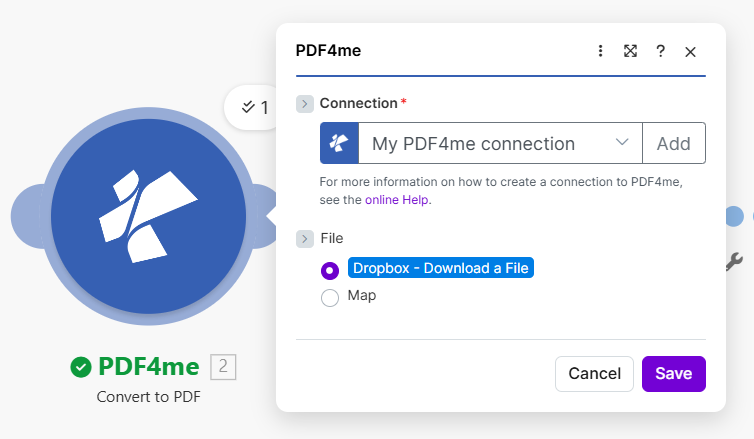
Convert to PDF module: Connection selected, File mapped from Dropbox – Download a File. PDF4me auto-detects format from the file extension.
Supported formats: DOC, DOCX, PPT, PPTX, XLS, XLSX, TXT, EML, BMP, GIF, JPEG, PNG, TIFF. PDF4me auto-detects the format from the file extension.
Step 3: Compress PDF
Scenario so far: Download → Convert to PDF → Compress PDF.
- Add PDF4me → Compress PDF.
- Connection — Select your PDF4me connection.
- File — Select PDF4me – Convert to PDF to pass the PDF from step 2.
- Profile — Max (or a lighter profile if you prefer).
PDF4me – Compress PDF: Reduce file size
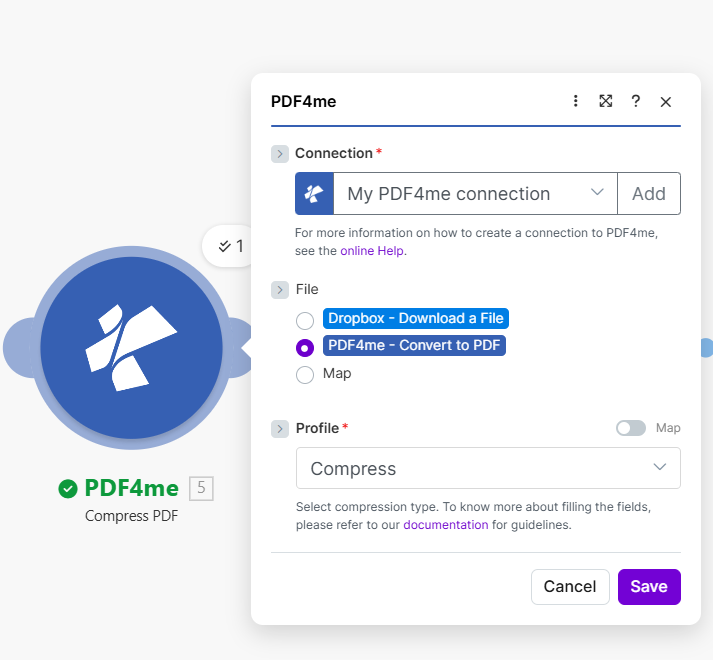
Compress PDF module: File from Convert to PDF, Profile set to Max. Smaller files archive and transfer faster.
Step 4: Convert to PDF/A
Scenario so far: Download → Convert to PDF → Compress PDF → Create PDF/A.
- Add PDF4me → Create PDF/A.
- Connection — Select your PDF4me connection.
- File — Select PDF4me – Compress PDF to pass the PDF from step 3.
- PDF/A Compliance — Choose a level. PDF/A-3b Basic Conformance is shown here; pick the standard that fits your requirements.
- Allow Downgrade — No (or Yes if you want flexibility for future compliance changes).
- Allow Upgrade — Yes (or No for strict archival).
- Save.
PDF4me – Create PDF/A: Archival configuration
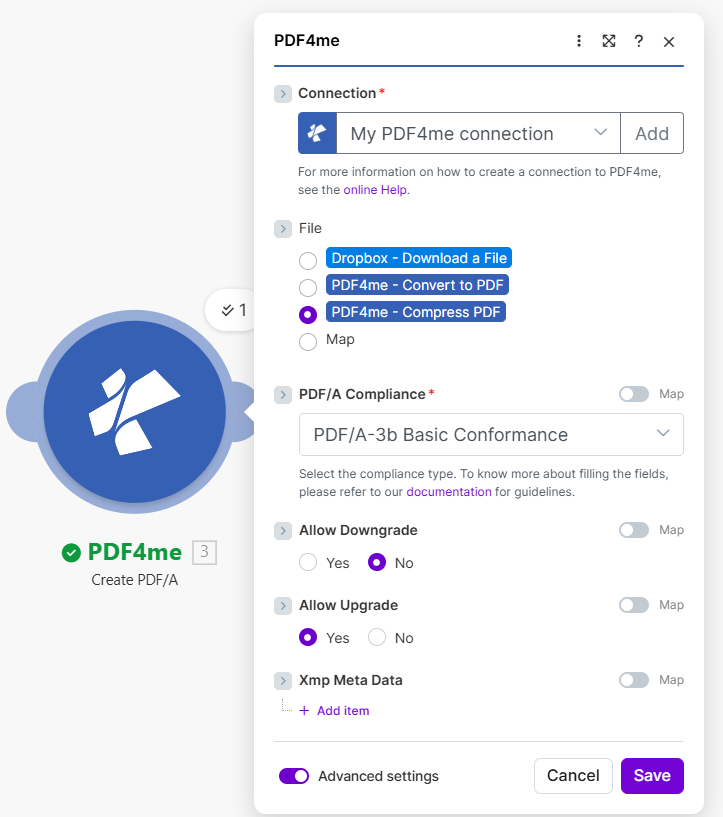
Create PDF/A module: File from Compress PDF, PDF/A Compliance (e.g. PDF/A-3b), Allow Downgrade (No), Allow Upgrade (Yes).
PDF/A compliance options
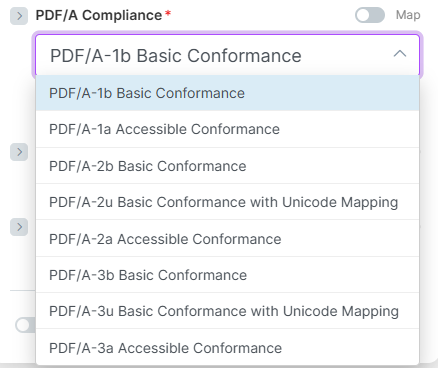
PDF/A-1b — basic visual integrity. PDF/A-1a — accessible with document structure. PDF/A-2 — newer standard with improved compression. PDF/A-3 — allows embedding other files (e.g. XML, Excel).
Step 5: Upload the Archival PDF
Scenario so far: Download → Convert to PDF → Compress PDF → Create PDF/A → Upload.
- Add Dropbox → Upload a File.
- Connection — Select your Dropbox connection.
- Folder — Enter the output path, e.g.
/Blog Data/PDFA/Output/. - File — Select PDF4me – Create PDF/A.
- File Name — e.g.
PdfA_MakeOutput.pdf. - Data — Map 4. Document (the PDF/A output from Create PDF/A).
- Overwrite an existing file — No (rename if exists) or Yes (replace).
- Save.
Dropbox – Upload a File: Save PDF/A to output folder
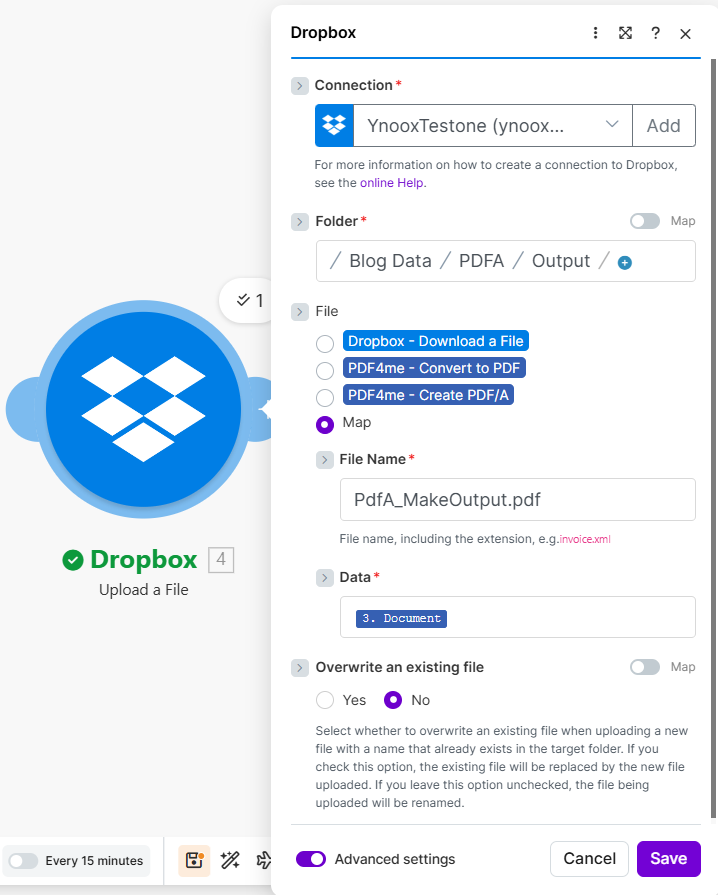
Upload module: Folder (/Blog Data/PDFA/Output/), File from Create PDF/A, File Name (PdfA_MakeOutput.pdf), Data mapped to 4. Document. Overwrite set to No.
Who Uses "Convert Then Archive"? Real-World Examples
Contract management: Signed agreements often arrive as Word or PDF. Convert Word to PDF, compress, then to PDF/A, and store in a compliant archive—ready for audits and legal hold.
Board reports and minutes: Presentations and Word docs from meetings need long-term retention. Convert, compress, archive, and keep them readable for years.
HR and compliance: Policies, handbooks, and training materials in Word or Excel often require archival. Convert to PDF/A so they meet retention and accessibility requirements.
Quick Reference: Key Settings
| Module | Setting | Example |
|---|---|---|
| 1. Dropbox Download | File | /Blog Data/PDFA/Word Sample.docx |
| 2. Convert to PDF | File | Dropbox – Download a File |
| 3. Compress PDF | File | PDF4me – Convert to PDF |
| 4. Create PDF/A | PDF/A Compliance | PDF/A-3b Basic Conformance |
| 5. Dropbox Upload | Data | 4. Document (from Create PDF/A) |
For full parameter details, see Convert to PDF — Make and Create PDF/A — Make.
Troubleshooting
Ensure the source filename includes the correct extension (e.g. .docx). PDF4me uses it to detect the input format.
In Upload a File, map 4. Document (or the Document output from Create PDF/A) to the Data field—that's the actual PDF/A content.
PDF4me Troubleshooting covers 401 (API key), 402 (credits), and more.
What's Next?
- Replace Dropbox Download with When a file is created (or similar) to process every new file automatically.
- Use an Iterator to batch-convert multiple files in one run.
- Already have PDFs? Use the Compress PDF then Create PDF/A scenario—no conversion step needed.