
PDF Delete Hyperlink in Make

What this module does

PDF4me — PDF - Delete Hyperlink strips all clickable hyperlink annotations from specific pages of a PDF without touching the visible text. Specify individual pages, a range, or the entire document in one step. Tools like UPDF and Adobe Acrobat require manual file-by-file editing — this module does it automatically inside your Make scenario for every document that passes through.

Authenticating Your API Request

Every PDF4me module in Make requires a valid Connection. Create or select one that holds your PDF4me API key so the scenario can call the hyperlink deletion service securely.

Important Facts You Should Not Miss

Text stays, only the link annotation is removed

The anchor text that was the clickable link stays exactly where it is — same font, same colour. Readers can read it, but clicking no longer does anything.

All links on the target pages are removed at once

Every hyperlink on the pages you specify is stripped in a single pass — there is no URL-level filter. If you need selective removal, run Extract Hyperlinks first to plan which pages to target.

PDF bookmarks and table-of-contents links are unaffected

Internal PDF bookmark navigation and table-of-contents anchors are completely untouched. Only external URL hyperlinks and in-page href clickable annotations are stripped.
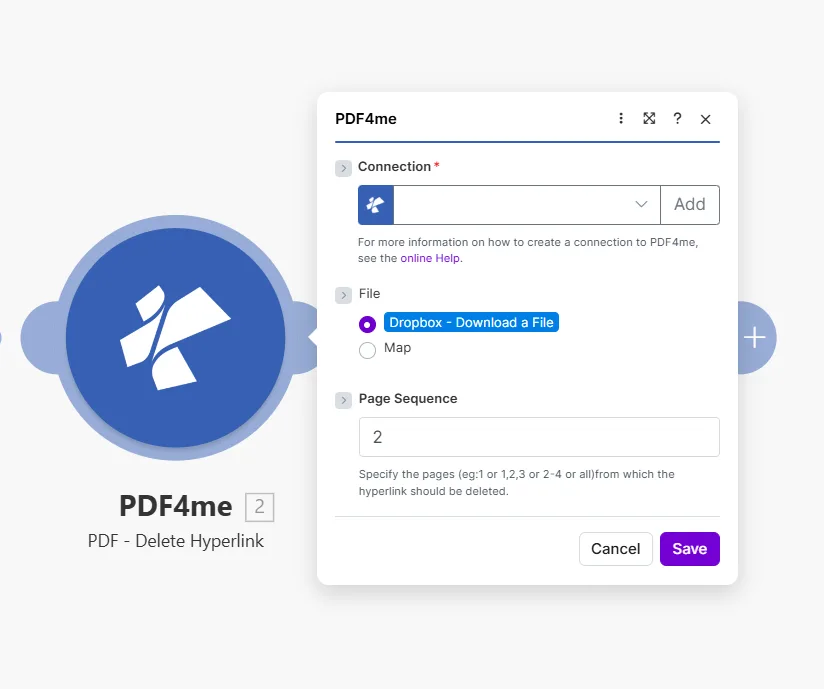
Make PDF4me PDF Delete Hyperlink module showing Connection field empty with Add button, File set to Dropbox - Download a File with Map option below, and Page Sequence field set to 2 with hint Specify the pages eg 1 or 1,2,3 or 2-4 or all from which the hyperlink should be deleted

Enter a single page, a comma-separated list, a range, or all to strip every link from the whole document.

Parameters

Required: All three parameters — Connection, File, and Page Sequence — must be provided for the module to run.

ParameterRequiredWhat it doesExample
ConnectionYesPDF4me API connection used to authenticate hyperlink deletion requests. Click Add to create one with your API key.Your PDF4me connection
FileYesSource PDF. Choose Dropbox - Download a File for a direct Dropbox trigger, or Map to supply the filename and binary content from a prior module.Dropbox - Download a File
Page SequenceYesWhich pages to strip of hyperlinks. Accepts a single page, comma-separated list, a range, or all to clean the entire document at once.2 or 1,2,3 or 2-4 or all

Quick Setup

  1. Add PDF4mePDF - Delete Hyperlink to your Make scenario.
  2. Select Connection (or click Add to create one with your API key).
  3. Set File to Dropbox - Download a File or Map from a prior module that outputs a PDF binary.
  4. Enter the pages to clean in Page Sequence — use all to strip links from every page in one shot.
  5. Save and click Run once. The output contains Document Name and Document Data — the PDF with all hyperlinks removed on the specified pages.

Workflow Examples

Workflow ExamplesCommon Make scenario patterns that use PDF - Delete Hyperlink to sanitize, prepare, and archive documents.
Sanitize a document before sending to a client
  1. A finished proposal PDF is placed in the "Ready for Client" folder in Google Drive.
  2. PDF - Delete Hyperlink runs with Page Sequence set to all.
  3. The returned link-free PDF is attached to a Gmail message and sent to the client.
  4. The original working copy in its source folder keeps all internal links intact.
Auto-create a print-ready version
  1. A Typeform submission marks a contract as approved and triggers the scenario.
  2. PDF - Delete Hyperlink strips all links from every page.
  3. The link-free PDF is uploaded to the "Print Queue" folder in Dropbox.
  4. Gmail notifies the print team that a new job is ready.
Monthly archive snapshot with no live links
  1. A scheduled scenario runs on the 1st of every month.
  2. Google Drive downloads the current active document.
  3. PDF - Delete Hyperlink removes all links from every page.
  4. The static snapshot is uploaded to an "Archive / [month]" folder — no dead links, no stale redirects.

Frequently Asked Questions

Does removing a hyperlink also delete the visible text?+
No. The module removes only the URI annotation — the invisible clickable layer — while leaving all visible text completely intact. The anchor text stays in its original position with the same font, size, colour, and formatting. Readers can still read the text; it just no longer responds to clicks or open a URL. This makes the module safe for sanitizing documents before print or client distribution, since the content itself is not altered. If you also need to remove or replace the visible text, add a Find and Replace module before or after Delete Hyperlink.
Can I target just one specific link and keep others on the same page?+
The module removes all hyperlinks from the pages you specify — there is no URL-level or text-level filter within a single Page Sequence value. If a page contains five links and you want to remove only one, this is straightforward only when the link you want to keep is on a different page. For more granular control, run Extract Hyperlinks first to get a full list of links and which pages they appear on, then decide which pages to pass to Delete Hyperlink. If links you want to keep share a page with those you want to remove, use Create Hyperlinks afterward to re-add the ones you want to preserve.
What page formats does Page Sequence accept?+
Page Sequence accepts four formats: a single page number like 1, a comma-separated list like 1,2,5, a hyphenated range like 3-7, or the word all to process every page in the document at once. For a 40-page report where you want to strip links from the cover and the appendix only, enter 1,35-40. Using all is the safest default when you want a fully link-free PDF in one step, since it covers every page regardless of total page count. The module returns an error if you specify a page that does not exist in the document, so use Get Document Information first when the total page count is unknown.
Does it affect internal bookmark links or the table of contents?+
No. The module only removes URI annotation objects — the clickable external URL links embedded in the PDF. Internal PDF bookmarks in the outline navigation panel, named destination anchors, and table-of-contents click-through links that jump to another page within the same document are stored as different annotation or action types and are completely unaffected. Readers can still navigate long documents using the table of contents after external links are sanitized. Cross-reference links pointing to headings within the document also remain intact.
Is my original source file changed in any way?+
No. PDF4me processes a server-side copy and streams the result back to Make as a new binary document in the Document Data output field. Your source file — whether in Dropbox, Google Drive, OneDrive, SharePoint, or passed as an email attachment binary — is never written to or modified. The original remains exactly as it was before the scenario ran. If you want to replace the source file with the sanitized version, add an upload module after Delete Hyperlink and explicitly overwrite the original path — that is a deliberate action your scenario takes, not something the PDF4me module does on its own.

Get Help